Are you NOT paying with Paypal? Perfect...Use DISC005 in your shopping cart to get -5% discount. Do not use this if you are paying with Paypal!
Coast Watchers
€89,99
Price incl. btw (21%) €15,62
Coast Watchers takes you into this struggle between Allied intelligence teams and Japanese hunters
In stock
1
Save this product for later
Coast Watchers
Product Details
From the Publisher:
The Coastwatchers saved Guadalcanal, and Guadalcanal saved the South Pacific.”
- attributed to Admiral William Halsey
THE HISTORY: The Australian Navy after the Great War developed a volunteer service to watch for unusual ships off the country’s shores. With colonial mandates over New Guinea and the Solomon Islands, “coastwatchers” there formed a warning fence against surprise attack. Each coastwatching station had a heavy but relocatable teleradio, one or two Australians (typically) in command, and a local network of indigenous scouts, spies, sentries, messengers, carriers, and canoe men.
Not originally envisioned as spies behind enemy lines, many coastwatchers found themselves as such when the Japanese invaded the region a few weeks after Pearl Harbor. If caught, they faced execution. Some 30 coastwatchers were taken over the course of the war.
But, through their individual adaptability and daring, the coastwatchers proved to be uncommonly successful field operatives, reporting on Japanese military buildups, rescuing fleeing civilians and castaway naval and air crew, occasionally picking off Japanese patrols and barges, and helping guide amphibious landings and overland marches in the eventual Allied counteroffensive.
“Forty bombers heading yours.” – Coastwatcher transmission to Guadalcanal
Most critically for the South Pacific campaign, the coastwatchers gave Allied forces distant early warning of Japanese air and naval sorties, such as the raids on Henderson Field or the vaunted “Tokyo Express.” Serving in effect as human over-the-horizon radar, the coastwatching network enabled Allied defenses to ready for, meet, and defeat strikes out of Japanese island and coastal bastions. As well, human operatives gave cover for the precious and perishable Allied codebreaking, as the public and the enemy would attribute any hints of Allied foreknowledge to the famed coastwatchers that the Japanese were already hunting.
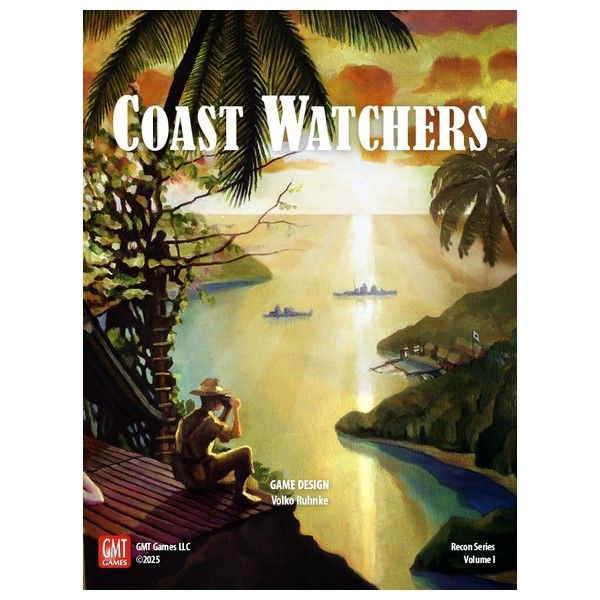
THE GAME: Coast Watchers takes you into this struggle between Allied intelligence teams and Japanese hunters. Standup blocks hide coastwatching stations, guerrillas, refugees, and stranded Allied crew. Gameboard recesses hold the blocks snug. Facedown counters hide the buildup of Japanese forces, which the coastwatchers seek to observe and report to headquarters. Other counters show where Japanese patrols are searching for coastwatchers or go into and get drawn from a cup to run Japanese searches and Allied delivery missions.
Each side has Mission cards. Allied Missions assign side tasks to the coastwatchers. Japanese Missions lay out secret military objectives for victory points, including air and sea operations against which the coastwatchers are to warn Allied forces. By hunting coastwatchers while building up military readiness and guiding operations, the Japanese player seeks to slip through the enemy intelligence net.
Players also draw Asset cards: special abilities to augment actions and perhaps add victory points.
Coast Watchers offers 15 standalone “Situations” plus 4 campaigns to tie them together. The Situations span the early-1942 Japanese incursion into the South Pacific to the neutralization of their great base at Rabaul by the end of 1943.
Components:
- One 22” x 17” Mounted Game Board with recesses
- Two 5” x 7” Patrol and Delivery Chit Mats
- 64 Illustrated Blocks
- 15 Pawns
- 90 Playing Cards
- Eight 8.5” x 11” 2-sided Situation Sheets
- Two 11” x 17” 2-sided player aid foldouts
- Two Sheets of 2-sided 5/8-inch Rounded Counters
- Scoring Sheets
- One Rulebook
- One Playbook
- Box, Insert, and Baggies
Players: 2
Playtime: 1-2 hours
Game Designer: Volko Ruhnke
Game Developer: Mike Sigler
Step into the shadows of the WWII Pacific Theater with Coast Watchers from GMT Games. Designed by legendary wargame innovator Volko Ruhnke (COIN Series, Nevsky, Labyrinth), this high-stakes game of field intelligence, hidden movement, and counter-reconnaissance covers the critical 1942–1943 South Pacific campaign.
Built for 1-2 players with session lengths between 60 and 120 minutes, Coast Watchers pit Allied intelligence networks—comprising brave Australian operatives, local indigenous scouts, and stranded airmen—against hunting Japanese security forces. Featuring wooden blocks with hidden information, secret mission cards, and a mounted board with recessed block slots, this title offers an intensely thematic cat-and-mouse struggle behind enemy lines.
Historical Context & The Human Radar Fence
As Admiral William Halsey famously noted, "The Coastwatchers saved Guadalcanal, and Guadalcanal saved the South Pacific." Following the rapid Japanese expansion after Pearl Harbor, small teams of Australian officers and brave indigenous islanders remained behind enemy lines across the Solomon Islands and New Guinea. Equipping themselves with heavy teleradios and supported by local networks of runners, canoeists, and sentries, these operatives acted as "human over-the-horizon radar," giving Allied forces crucial early warnings of Japanese air strikes and naval sorties.
In Coast Watchers, you experience this perilous struggle from both perspectives. The Allied player must set up covert observation posts, rescue downed airmen, evacuate refugees, and report enemy fleet movements to headquarters—all while avoiding capture. The Japanese player commands security forces, patrol barges, and military garrisons, striving to hunt down enemy spies while executing secret military objectives.
Innovative Mechanics & Fog of War
Volko Ruhnke crafts a tense operational puzzle driven by hidden deployment and risk management:
- Hidden Block Intelligence: Standup blocks held in recessed board slots hide coastwatching stations, native guerrillas, castaways, and fake signals from the Japanese player.
- Hidden Japanese Forces: Facedown counters conceal the scale of Japanese military buildups, forcing the Allied player to scout dangerous zones to gather vital intelligence.
- Chit-Pull Searches & Delivery Missions: Draw-cup mechanics resolve Japanese search patrols and Allied resupply drops, keeping every turn filled with tactical suspense.
- Secret Mission & Asset Cards: Both commanders hold private Mission cards assigning side goals and operational targets, while Asset cards trigger unexpected field tactics and support abilities.
Unmatched Replayability & Solitaire Engine
Coast Watchers includes 15 standalone "Situations" spanning the early 1942 Japanese invasion through the late 1943 isolation of Rabaul. For deep story arcs, 4 linked campaign modes allow players to carry results forward across multiple scenarios. Additionally, the game comes equipped with a dedicated solitaire system, allowing a single player to test their skills against an automated Japanese hunter AI.
BOARDGAMEGENERAL ADVICE
Expert Recommendation
At Boardgamegeneral, we are huge fans of Volko Ruhnke’s work, and Coast Watchers is one of GMT’s most innovative historical titles in years. Departing from traditional hex-and-counter fleet or army combat, it zeroes in on the vital, nerve-wracking world of tactical intelligence and jungle evasion.
With an accessible complexity level, it is significantly easier to table than massive operational wargames, while providing intense head-to-head mind games. The use of wooden blocks sitting inside recessed board spaces keeps the fog of war crisp and clean, ensuring that neither player ever has total certainty about what lies in the next cove or jungle thicket.
If you enjoy deduction, hidden movement, WWII history, or asymmetric games, Coast Watchers is an absolute must-have for your tabletop collection.
Verdict: A masterclass in hidden-information design. Volko Ruhnke turns field reconnaissance into an addictive, deeply thematic two-player duel.
Display prices in:EUR