Are you NOT paying with Paypal? Perfect...Use DISC005 in your shopping cart to get -5% discount. Do not use this if you are paying with Paypal!
Thunderbolt
€69,99
Price incl. btw (21%) €12,15
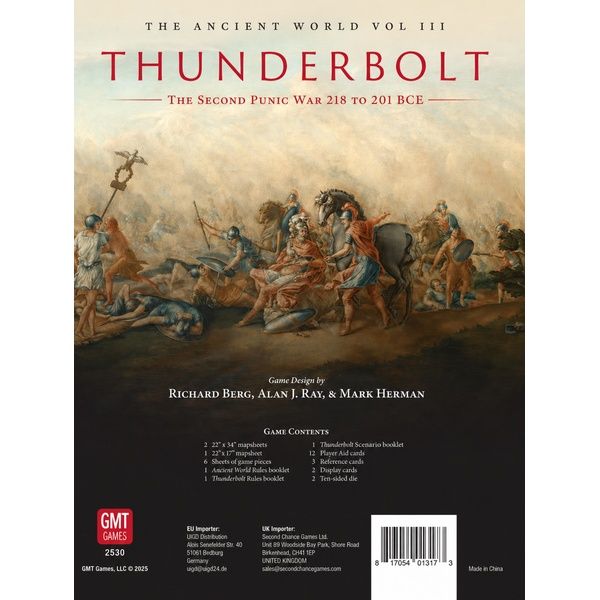
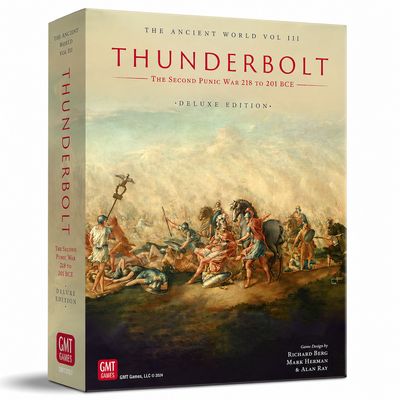
Command Hannibal or Rome in Thunderbolt by GMT Games.
In stock
1
Save this product for later
Thunderbolt
Product Details
From the Publisher:
Prior to his passing, Richard H. Berg was hard at work completing the third volume in his The Ancient World series, Thunderbolt, covering the titanic 2nd Punic War between Rome and Carthage. Mark Herman has teamed up with series developer Alan Ray to finish the game.
Thunderbolt brings The Ancient World system to the mammoth 2nd Punic War. The game covers the action in the Western Mediterranean on updated Italy and Africa maps published in the prior two volumes, plus a connecting full-size map of Spain and western Mauretania, the last map design of Richard’s long and illustrious career.
The Ancient World system uses a chit pull mechanic to drive the action with the better leaders having more opportunities to act. There are no movement allowances; instead attrition and the ability of a leader to continue to conduct operations govern how forces can move. Battles are straightforward, resolved with a couple of die rolls and an extensive list of modifiers to account for cavalry superiority, elite status, and leadership, as well as numbers of troops. The Battle Results Table features an “Unpredictable Result” which can turn the tables on the best laid battle plan. All the trappings around the decisive moment are there as well: Interception, Avoidance, Coordination, Retreat, Pursuit & Butchery, and after battle effects. Sieges are covered in detail, including rules for attrition, assaults, repair and reduction, treachery, and surrender. And what would a Richard Berg game be without random events—Auguries in this system.
The Ancient World system models the Roman and Carthaginian political systems which provide a framework for campaigning during the Game Turn/year. A hierarchy of magistrates commands the Roman Legions in the field: Consuls, Proconsuls, Praetors, and occasionally a Dictator. These magistracies are filled from a pool of over 60 historical personages meticulously assembled by Richard from the sources and individually rated for their capabilities (or lack thereof). Each magistrate is given an Imperium, one or two Legions to command, and a specific area on the map to conduct operations. Changes to the area of operations may change while campaigning but only by permission from the Senate.
The Carthaginians also have a hierarchy of army commanders: Overall Commander, Army Commander, and Subordinate Commander drawn from a pool of over 20 historical personages rated in the same manner as the Roman leaders. Unlike the Romans, the commanders are permanently assigned to a specific army unless recalled or other circumstances dictate otherwise. The Carthaginian family in power and the overall Carthaginian political climate is determined each Game Turn/year. The results determine how many armies the Carthaginians will field and where they can campaign. Hannibal and his army are an exception—he can come and go as he pleases.
New to The Ancient World system are the Celtic and other tribes that populated the Iberian peninsula and northern Italy. These tribes, over 20 in number, are represented on the map with counters rated for Aggression and the ability to provide troops. Each tribe can be either allied to Rome or Carthage or Neutral. Tribes can be used to attack the player’s opponent or provide troops. Tribes can be attacked and pacified. Diplomacy can be used to alter a tribe’s allegiance.
Naval matters are not ignored, but due to the paucity of significant naval engagements, the scenarios use The Ancient World’s simpler Naval Superiority System to streamline play.
Thunderbolt will feature several smaller scenarios (most playable on a single map) along with the 2nd Punic War grand campaign played on all three maps. The planned scenarios include:
- 2nd Punic War: The entire 2nd Punic War. Three maps, 16 Game Turns. A wealth of special rules to bring this conflict into sharp focus.
- Thunderbolt: Hannibal's Invasion of Italy. One map, 3 Game Turns (218-216 BCE). A reappraisal of the scenario from Rise of the Roman Republic. An excellent introductory scenario.
- Italian Campaign: Hannibal’s campaign in Italy. One map, 16 Game Turns (218-203 BCE)
- The Spanish Campaign I: The Roman Invasion of Spain. One map, 8 Game Turns (218-211 BCE).
- The Spanish Campaign II: Scipio Strikes Back. One map, 5 Game Turns (209-205 BCE).
- The Island Contest: The Carthaginian Invasions of Sicily and Sardinia. Two maps, 5 Game Turns (215-211 BCE)
- The African Campaign: Scipio Africanus’ Invasion of Africa. One map, 3-4 Game Turns (204-201 BCE)
- Iberia: Carthage’s Conquest of Spain. One map, ~16 Game Turns (237-220 BCE)
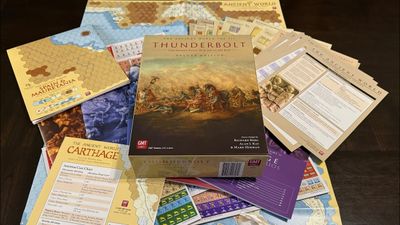
Components:
- Two 10-sided dice
Maps
- Two 22” x 34” maps (Italy and Spain)
- One 22” x 17” map (Africa)
Counters
Six Countersheets (½” - 280 per sheet) -> 1,680 counters
Booklets
- One The Ancient World v3.0 series rules booklet
- One Thunderbolt Exclusive rules and scenarios booklet
Player Aid Cards
- Four 11” x 17” Ancient World PACs (one set of two for each player)
- Two 11” x 17” 2nd Punic War Scenarios PAC (one for each player)
- Two 8 ½” x 11” Celts Charts and Tables PAC (one for each player)
- One 8 ½” x 11” Roman Charts and Tables PAC
- One 8 ½” x 11” Carthaginian Charts and Tables PAC
- One 8 ½” x 11” Advanced Naval System Charts and Tables PAC
- One 8 ½” x 11” 2nd Punic War Auguries PAC
- One 8 ½” x 11” Roman Magistrate Quick Reference Card
- One 8 ½” x 11” Map Gazetteer Card
Display Cards
- Two 8 ½” x 11” Roman Army Displays
- One 8 ½” x 11” Carthaginian Army Display
- One 8 ½” x 11” Alliance Level/Game Turn Tracks Display
- One 8 ½” x 11” Carthaginian Political and Manpower Display
- Two 8 ½” x 11” City Occupation Displays
Time Scale: 1 year per turn
Map Scale:
13 miles per hex
Unit Scale: Strength point = either 500 men, 300 cavalry, or 10 elephants
Players: 1-2
Game Designers: Richard H. Berg, Mark Herman, and Alan Ray
Series Developer: Alan Ray
Confront the legendary might of Rome and Carthage in Thunderbolt, a deep operational-scale wargame published by GMT Games.
Theme and Historical Setting
Thunderbolt marks the triumphant return of The Ancient World series, initially crafted by the legendary late designer Richard H. Berg and brought to completion by wargaming masters Mark Herman and Alan Ray.
Core Gameplay and Major Mechanics
The mechanical heart of Thunderbolt lies in its abandonment of traditional movement points. Instead, military momentum is governed by commander capability and logistically grueling attrition.
The operational engine runs on an asymmetric chit-pull mechanic. Activation chits are blindly drawn from a cup, introducing a brilliant layer of fog-of-war. Exceptional military minds—such as Hannibal Barca—benefit from multiple chits in the pool, granting them the ability to execute fluid, consecutive maneuvers. Conversely, the politically fractured Roman leadership must struggle against bureaucratic stagnation.
The gameplay flow heavily features:
- Operations and Maneuver: Armies march across vast networks, attempting to catch opponents out of position while handling dynamic mechanics like Interception and Avoidance.
- Siegecraft: Cities are not easily taken. Detailed rules govern starvation attrition, tactical assaults, structural reduction, and political treachery.
- Resolution of Clashes: Battles are clean yet deeply tactical, decided by direct die rolls heavily modified by cavalry superiority, troop quality, and leadership values.
Beware the Battle Results Table's Unpredictable Result factor, which can instantly unravel a perfect strategy. - Auguries: Random historical events—ranging from political realignments to unforeseen natural crises—ensure no two years of the war play out identically.
Player Experience, Replayability, and Solo Play
What sets this game apart for historical board gaming enthusiasts is the inclusion of the Iberian and Celtic tribal factions. Rather than acting as static roadblocks, these neutral forces form a volatile political buffer zone that can be bribed, swayed, or subjugated.
Designed gracefully for 1 to 2 players, the open-information nature of the maps combined with the chaotic nature of the chit-pull activations makes Thunderbolt an outstanding, high-narrative solo wargame out of the box.
BOARDGAMEGENERAL ADVICE
At Boardgamegeneral, we always appreciate a wargame that respects historical logistics over abstract math, and Thunderbolt delivers exactly that. This standard edition strips away the multi-game baggage of the deluxe box, offering a targeted, laser-focused look at the Punic Wars.
This title is perfectly tuned for intermediate to veteran wargamers who enjoy grand strategic operational movement and theater management. If you love the core philosophies of systems like SPQR, Great Battles of History, or Hannibal: Rome vs. Carthage, you will immediately appreciate how neatly this system models ancient command.
Its absolute greatest strength is the chit-pull command structure, which beautifully simulates the frustration of managing uncoordinated armies alongside the brilliance of military geniuses. The detailed siege mechanics also add fantastic tactical texture. On the downside, the system's focus on supply lines and unique attrition movement means it has a distinct learning curve; complete beginners to traditional hex-and-counter games might find the manual quite dense.
Verdict: A masterfully focused, highly replayable operational simulation that deserves a premium spot on the table of any dedicated ancient-history enthusiast.
You May Also Like
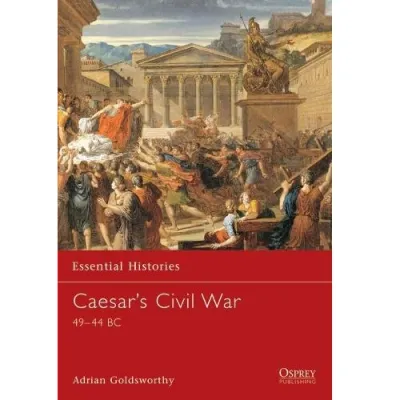
Essential Histories 42: Caesar’s Civil War 49-44 BC
Essential Histories 42: Caesar’s Civil War 49-44 BC
A concise history of Caesar, Pompey, and the Roman civil war that transformed the Republic.
€13,99
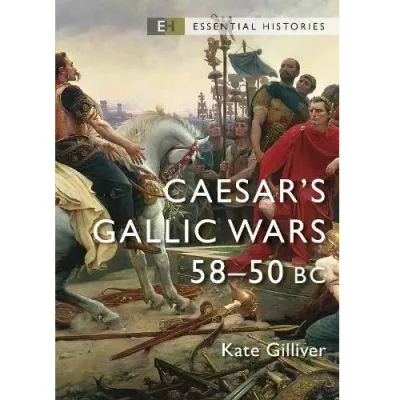
Essential Histories: Caesar’s Gallic Wars
Essential Histories: Caesar’s Gallic Wars
A concise illustrated history of Julius Caesar’s conquest of Gaul and its role in Rome’s political crisis.
€13,99
Sold out
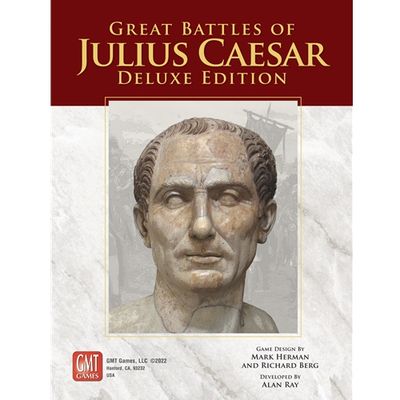
Great Battles of Julius Caesar Deluxe Edition
Great Battles of Julius Caesar Deluxe Edition
A deluxe Great Battles of History game covering Caesar’s campaigns with 20 tactical battles across Gaul and the Civil War.
€89,99
Out of stock
Thunderbolt Deluxe Edition
Thunderbolt Deluxe Edition
The definitive grand-tactical wargame covering the epic clash between Rome and Carthage. Designed for 1 to 2 players
€92,99
Display prices in:EUR