Are you NOT paying with Paypal? Perfect...Use DISC005 in your shopping cart to get -5% discount. Do not use this if you are paying with Paypal!
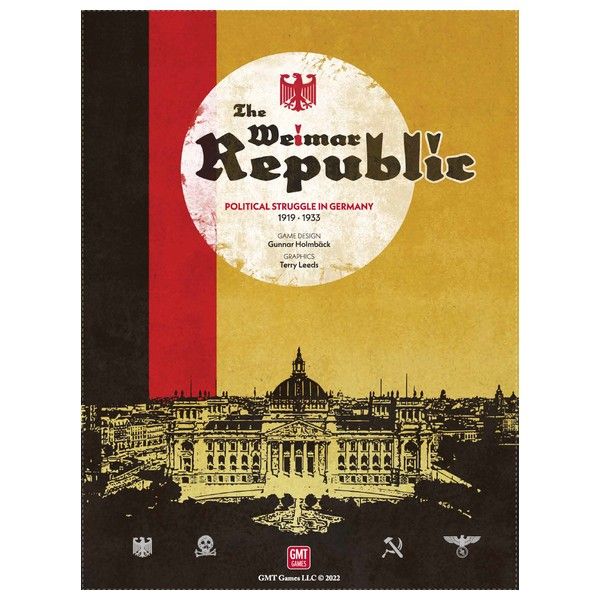
The Weimar Republic
€72,99
Price incl. btw (21%) €12,67
The Weimar Republic is a Card Driven Game of political struggle in interwar Germany
In stock
1
Save this product for later
The Weimar Republic
Product Details
From the publisher:
January 19, 1919. The Great War is over, the Kaiser has abdicated, and Germany is on its knees. After suffering a humiliating loss at the hands of the Allied nations, the former Great Power is now confronted not only with the death of millions of its citizens, but also with a severe economic crisis and a political turmoil that threatens to plunge the entire nation into civil war. The November Revolution of 1918 ushered in a new era of liberal democracy in a country traditionally ruled by noblemen warriors. The first democratic election has now been held, but democracy’s enemies are numerous, and the future of the fledgling Republic appears grim. No one can tell whether the democratic Coalition will prevail or whether any of the extremist factions will rise out of the chaos and seize power.
One thing is perfectly clear, however: the coming years will not be remembered for their peace and stability.
The Weimar Republic is a Card Driven Game of political struggle in interwar Germany. Four factions compete for dominance: the democratic Coalition, the Soviet-backed Communist Party, Hitler’s National Socialists, and the far-right Radical Conservatives.
The game follows a timeline of 15 years (1919-1933) with two rounds in each year. During a round, players take turns using their faction-specific abilities to increase their influence in Germany’s regions and major cities, to maneuver the political landscape of the Republic, and to dominate through a combination of propaganda, parliamentary elections, street violence, economic influence, and ideological zeal.
Typical actions include agitation, reforms, recruitment and deployment of fighting men, strikes, uprisings, assassinations, and coups. General and regional elections are held at irregular intervals throughout the game, potentially shifting local power balances in sometimes radical ways. The timeline moves through three distinct eras, each with its own deck of event cards. There are also several special cards like Elections and Parliamentary Control Cards.
Gameplay is fast-paced; initiative flows back and forth, and the direction of the game may change rapidly and unexpectedly. Although competition between the factions is fierce, some of the faction-specific mechanics overlap, and players can often take advantage of each other--including the making and unmaking of alliances.
The Weimar Republic includes scenarios ranging in length from 3 to 8 hours and a special tutorial scenario that can be played by new players in only 90 minutes. Victory is absolute and generally achieved through “sudden death”; there is no final scoring or adding up of different objectives. Each faction can be replaced by a "bot" player, allowing 1-4 players to play with any combination of factions.
The Weimar Republicconfronts players with difficult choices and questions not only in terms of gameplay. The historic downfall of the Republic to the threat of totalitarianism was not merely manifest in the National Socialist movement. In 1919, the embryo of the NSDAP was hidden deep within the heterogeneous far Right, and Hitler was known to few outside Bavaria's ultra-nationalist circles. Reactionary militarist forces, armed Bolsheviks, and a broken economy presented much more acute threats to the Republic during its early years than did National Socialism. The Weimar Republic allows players to explore democracy's inherent frailty through the "what if" scenarios about which historians (and gamers) so often speculate.
What if things had taken another turn some time during the twenties? What if the KPD, the Soviet-backed Communist Party, had obtained parliamentary control in key states or launched a successful revolution? What if the radical Right had managed to gain broad popular support before Hitler outmaneuvered the old reactionary elites? What if the democratic coalition had managed to stay together, unite the German people, and deliver the progressive, democratic welfare state that was promised from the outset?
These questions are not only historical in nature. Hitler’s seizure of power in 1933 had enormous consequences for Germany, Europe, and the entire world--consequences that still echo today. What would our present situation be like if he had failed in his political aspirations or if his ascension to power had come earlier? In The Weimar Republic, the outcome is up to you, the players!
Components
- A 22” x 34” mounted mapboard
- 4 Player Mats
- A deck of 165 cards
- 150 yellow, red, brown, and black Influence Cubes
- 3 black Conservative Clique Squares
- 8 white pawns and 4 colored pawns
- A sheet of full-color counters
- 4 six-sided dice
- 4 Player Aids
- 1 reference sheet
- Rulebook
- Playbook
Game Designer: Gunnar Holmbäck
Game Developer: Jason Carr
Navigate the turbulent interwar years with The Weimar Republic from GMT Games.
Four asymmetric factions—the Democratic Coalition, the Communist Party (KPD), the Radical Conservatives, and the National Socialists (NSDAP)—clash across major German cities and regions.
Interwar History & Asymmetric Political Conflict
Set against the chaotic backdrop of post-WWI Germany, The Weimar Republic simulates fifteen crucial years of social, economic, and political upheaval.
The game features four radically asymmetric factions vying for influence over the German map:
- The Democratic Coalition: Fights to stabilize the republic, pass social reforms, and maintain public order amidst economic crises.
- The Communist Party (KPD): Seeks to spark a worker-led socialist revolution using general strikes, street agitation, and Soviet support.
- The Radical Conservatives: Strives to restore autocratic order, utilizing military connections and paramilitary Freikorps forces.
- The National Socialists (NSDAP): Begins as a fringe Bavarian group and attempts to exploit social unrest, build regional strongholds, and dismantle democratic institutions.
Card-Driven Mechanics & Sudden Death Tension
Building on GMT's legendary Card-Driven Game (CDG) heritage, The Weimar Republic gives every player a hand of multi-use event cards each round.
Elections—both regional and general—trigger dynamically throughout the game, dramatically shifting political power across the provinces. Rather than relying strictly on end-game scoring, victory can occur through sudden-death conditions if a faction reaches its specific dominance threshold, keeping every turn filled with intense player interaction and high-stakes negotiation.
Component Excellence & Solitaire System
Published with GMT's signature component standards, the game includes a mounted map of interwar Germany, custom wooden influence markers, cardboard control tokens, and three distinct historical card decks spanning different eras of the republic.
For solo players or small groups, the game includes a robust automaton system (bots) for all non-player factions, allowing any combination of 1 to 4 human and AI players without sacrificing tactical depth or political tension.
BOARDGAMEGENERAL ADVICE
Expert Recommendation
At Boardgamegeneral, we have a profound appreciation for GMT's political and historical simulations. With a complexity score of 3.00 / 5, The Weimar Republic hits an ideal middle ground for historical gamers. It offers the deep narrative tension of classic 4-player political games like Twilight Struggle or Churchill, but uses an intuitive action system that keeps turns moving rapidly.
The key strength of this title lies in how authentically it models the precarious nature of interwar politics. Unlike traditional wargames where direct military force dominates the map, here your primary weapons are political influence, parliamentary coalitions, economic stability, and public opinion.
Prospective players should note that the game deals directly with complex historical themes and extreme political ideologies of the 1920s and 30s. For gaming groups that enjoy heavy negotiation, emerging narrative, and deep historical strategy, it stands out as one of GMT's finest modern card-driven designs.
Verdict: An essential purchase for fans of political CDGs, historical wargames, and multi-faction strategy. It offers an incredible blend of historical narrative, asymmetric strategy, and sudden-death tension.
You May Also Like
Mr. President: The American Presidency, 2001–2020 2nd Edition
Mr. President: The American Presidency, 2001–2020 2nd Edition
A deep solitaire strategy game about governing the United States in the 21st century.
€99,99
Sold out
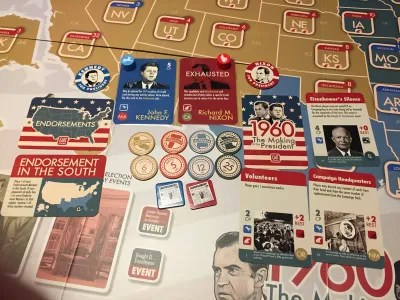
1960: The Making of a President (2nd Printing)
1960: The Making of a President (2nd Printing)
A card-driven strategy game of the 1960 U.S. presidential election.
€69,99
Out of stock
Mr. President Upgrade Kit
Mr. President Upgrade Kit
Upgrade your 1st Edition copy of Mr. President with revised 2nd Edition materials.
€28,99
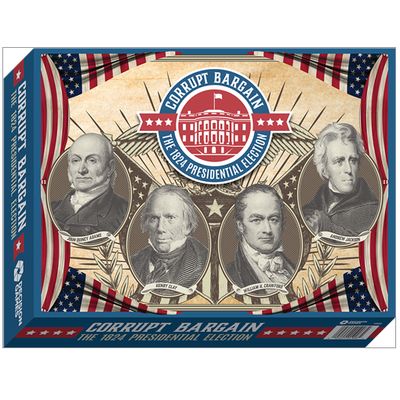
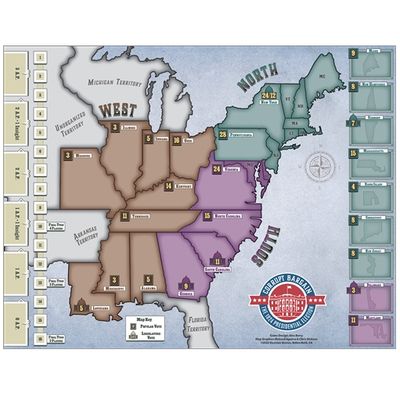
Corrupt Bargain: The 1824 Presidential Election
Corrupt Bargain: The 1824 Presidential Election
Campaign for Adams, Jackson, Crawford, or Clay in this card-driven game of the 1824 U.S. presidential election.
€62,99
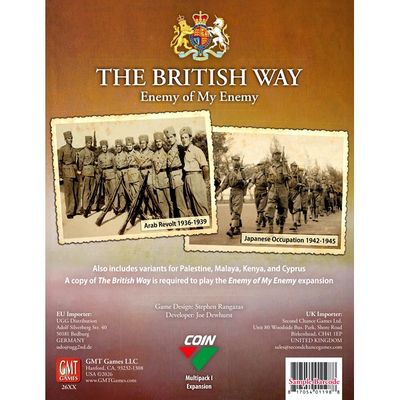
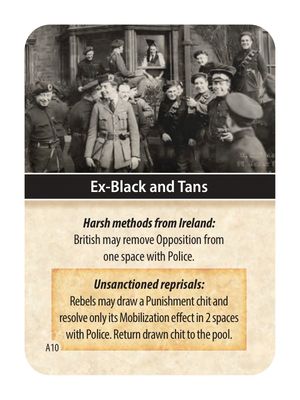
The British Way: Enemy of My Enemy
The British Way: Enemy of My Enemy
The British Way: Enemy of My Enemy by GMT Games COIN series
€55,99
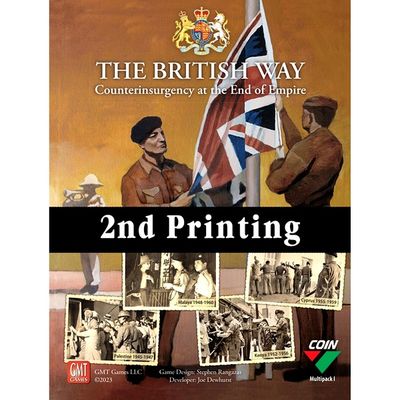
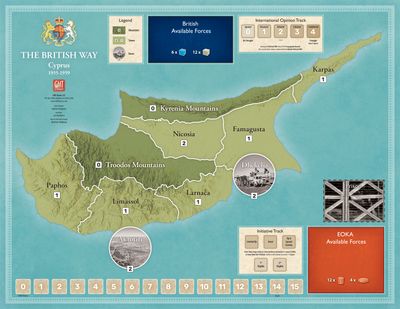
The British Way: Counterinsurgency at the End of Empire 2nd Printing
The British Way: Counterinsurgency at the End of Empire 2nd Printing
The British Way: Counterinsurgency at the End of Empire 2nd Printing
€92,99
Display prices in:EUR